Discovering Hidden Gems in Skill Development: A Deep-Dive into Breakthrough Techniques
When it comes to mastering new skills, most people follow well-trodden paths — enroll in a course, follow expert advice, and practice regularly.
While these steps work to a degree, they rarely lead to exceptional results.
The truth is, beneath the surface of traditional methods lie hidden gems — lesser-known techniques and frameworks that offer breakthrough discoveries for those willing to explore deeper.
In this post, we’ll take a deep-dive analysis into these overlooked strategies and examine how they can completely transform your learning journey, elevate your abilities, and unlock levels of performance you never knew were possible.
The Fallacy of “Just Practice More”
A common myth in skill development is that the more you practice, the better you get.
But countless hours of practice can lead to diminishing returns if they’re not applied with insight and precision.
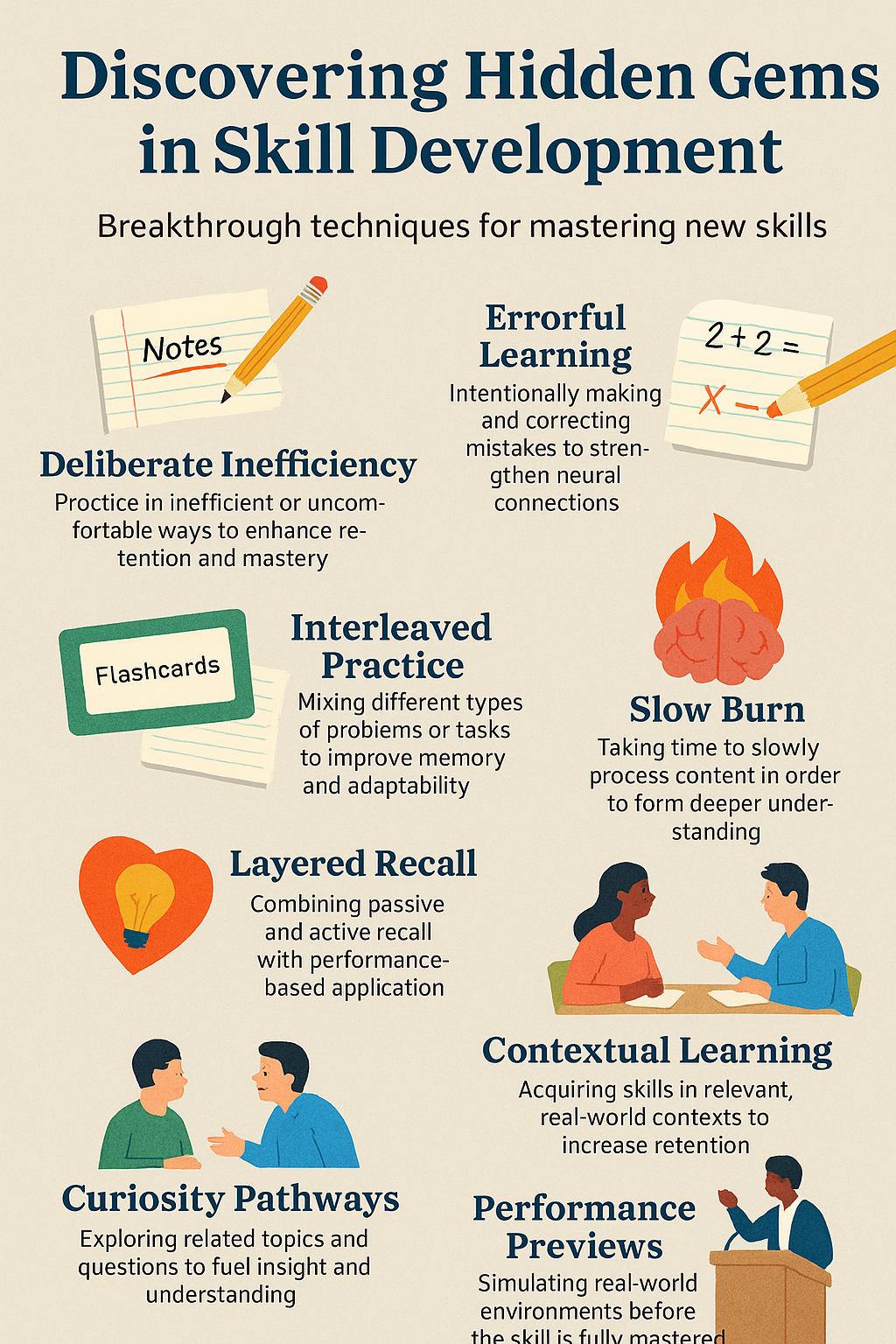
Enter the concept of deliberate inefficiency — one of the hidden gems that elite learners leverage.
This technique involves intentionally practicing in uncomfortable or inefficient ways to activate deeper cognitive processing.
For example, instead of typing notes, handwrite them. Instead of using digital shortcuts, perform tasks manually.
These small “inefficiencies” force your brain to engage more deeply, which enhances retention and mastery.
Hidden Gem: “Errorful Learning”
While conventional wisdom promotes error-free practice, researchers have discovered the benefits of what’s called errorful learning — making and correcting mistakes during the learning process.
Rather than aiming for perfection, this method encourages intentional trial and error.
The act of failing and recovering from it builds stronger neural connections than error-free repetition. It’s particularly powerful in language acquisition, problem-solving, and skill improvisation.
This approach transforms mistakes from setbacks into cognitive leverage points, offering a breakthrough method for solidifying knowledge and boosting confidence.
Breakthrough Discovery: The Role of Interleaved Practice
One of the most underused strategies in skill building is interleaved practice — mixing different types of problems or tasks within a single session.
Unlike blocked practice, where you repeat the same task over and over, interleaving forces your brain to constantly adapt and switch contexts.
Let’s say you’re learning guitar. Instead of playing the same scale repeatedly, switch between different scales, chords, and tempos.
This variation strengthens long-term memory and increases adaptability, both of which are essential for real-world application.
Studies have shown that interleaved practice significantly outperforms traditional methods when it comes to retention and transferability — making it a hidden gem in the world of cognitive science.
Deep-Dive Analysis: Why Contextual Learning Works
Contextual learning refers to acquiring skills within the context they’ll be used, rather than in isolation.
This means learning negotiation through real business deals, or practicing storytelling by actually producing short films or podcasts.
The brain encodes information more efficiently when it’s linked to real-world relevance.
This is known as situated cognition, and it’s a core component of how top performers learn — not through abstraction, but through embedded experience.
Want to master sales? Shadow a top closer in real calls. Learning to code? Contribute to an open-source project.
Context injects meaning and urgency into learning, making it stickier and more usable.
Hidden Gem: The “Slow Burn” Technique
Most learners race to absorb content, treating speed as a metric of success. But top performers know that slowing down can dramatically improve depth and clarity.
The “slow burn” technique involves consuming content at half speed, dissecting it line-by-line, and reflecting after each major concept.
This isn’t about laziness — it’s about deep processing, which the brain craves for long-term retention.
Slow learning builds stronger neural pathways. It allows for connections to form, analogies to emerge, and insight to take root — all of which are necessary for high-level application.
Breakthrough Discovery: Layered Recall Systems
Standard memory techniques like flashcards only scratch the surface.
Experts use layered recall systems — combining passive recall (like reading or hearing) with active recall (like quizzing or summarizing), followed by performance-based recall (applying in real time).
Here’s how this works in practice:
-
Learn a new concept.
-
Summarize it from memory the next day.
-
Teach it to someone by the end of the week.
-
Apply it in a live setting by the month’s end.
This pyramid of recall multiplies retention and skill fluency. It’s a game-changer for anyone seeking deep mastery — and it’s surprisingly rare outside expert circles.
Deep-Dive Insight: The Neuroscience of “Spacing”
One of the most consistently validated findings in learning science is the spacing effect — spreading study sessions out over time improves long-term retention.
But elite performers take it further. They combine spacing with strategic compression — short, high-intensity bursts of learning before long breaks.
Think of it like interval training for your brain.
This rhythm of focus and rest mimics natural memory consolidation cycles and boosts retention by synchronizing with the brain’s neuroplasticity window.
If you’re trying to master any high-cognitive-load skill, this hybrid model of spaced + compressed learning is a breakthrough worth adopting.
Hidden Gem: Curiosity-Driven Learning Pathways
While goal-driven learning is common, curiosity-driven learning is a hidden gem that’s underused by adults.
When you let your curiosity lead, you engage the brain’s dopaminergic system — which enhances motivation, focus, and reward sensitivity.
In practice, this means exploring side questions, diving into related disciplines, or chasing intuitive hunches.
While it may seem inefficient, curiosity often unlocks innovative insights and broader understanding — crucial elements for creativity and problem-solving.
Many polymaths and innovators credit their breakthroughs to curiosity-driven exploration, not rigid learning schedules.
Breakthrough Method: Performance Previews
Another deep tactic is the use of performance previews — simulating the environment where the skill will be tested before full mastery is achieved.
If you’re preparing to speak publicly, rehearse in front of friends in a noisy room. If you’re learning trading, do live simulations with real market fluctuations.
These previews act as “soft launches” for your skill, exposing you to pressure while giving space for correction.
They help bridge the gap between controlled practice and unpredictable reality — a step that most learners skip, to their detriment.
Final Thoughts
Skill mastery isn’t just about effort; it’s about insight. The world’s best learners don’t rely solely on common strategies — they go deeper.
They find hidden gems in the science of learning, harness breakthrough discoveries, and apply them through rigorous, real-world practice.
By embracing layered recall, contextual experience, curiosity pathways, and slow burn techniques, you can tap into reservoirs of performance that most never access.
These strategies may not be the loudest or flashiest, but they’re often the most effective — quietly powering the success of elite performers around the globe.